
The Future Has Arrived: 5 Counterintuitive Insights About Online Ads in 2026 You Can't Ignore
Advertising in 2026 is a symbiosis: heavy execution belongs to AI, but strategic sovereignty and creative authenticity belong to the human.
Listen to the summary
The Future Has Arrived: 5 Counterintuitive Insights About Online Ads in 2026 You Can't Ignore
1. The Digital Sameness Crisis: The Algorithm Doesn't Want Your Money, It Wants Your Intelligence
In 2026, we reached the apex of saturation. With the ubiquity of Generative AI, the market has been flooded by a "crisis of sameness": technically impeccable but strategically sterile ads. The advent of Generative AI Overviews and the rise of Zero-Click Search (estimated at up to 60% of searches) have changed the rules of the game.
Success now does not depend on "spending more", but on "feeding the algorithm with intelligence". The vanity metrics of 2024 are obsolete. Beating the algorithm in 2026 requires a transition from reactive automation to what we call Conversion Probability Modeling. If you're still optimizing for the click, you've already lost; the winner is the one who trains the AI to predict customer lifetime value even before the first access.
Pro-Tip Strategist: Stop fighting "Zero-Click". Integrate your brand directly into AI responses through conversational and native content. The goal is not just traffic, it's the sovereignty of the response.
2. The Paradox of Authenticity: The "Human Factor" as a Defense Against AI Fatigue
In an ecosystem dominated by flawless video generated by tools like Veo 3.1 and Imagen 4, synthetic perfection has become background noise. The great paradox of 2026 is that the scale of AI has created an unprecedented demand for the imperfect. "Generic AI Fatigue" is real, and consumer trust is now a commodity earned by real narratives and authentic User-Generated Content (UGC). According to WordStream:
"Ads that have a real human feel, and not something that looks like it's being sold by a machine, will perform better. Real images and authentic copies will stand out against AI-generated ads in 2026."
Emotional connection is your only shield against infinite scrolling. Brands that use Product Studio to create ad variants while maintaining the lo-fi and human aesthetic are capturing the attention that purely synthetic creatives miss.
3. Goodbye, Keywords; Hello, Signals: The Age of Predictive Segmentation and GEO
The era of exact keyword match is a closed chapter. In Google and Meta Ads 2026, we operate under the logic of "Signals" (demographic, behavioral, and real-time intent). Tools like AI Mode and Advantage+ Audience now use Smart Bidding Exploration to uncover latent intents before the user even formulates a search.
The three fundamental changes in segmentation are:
- First-Party Data Sovereignty: The algorithm is only intelligent if you provide it with your customer list and CRM data via Data Manager API.
- Predictive and Probabilistic Bidding: Bids adjusted for the statistical probability of immediate conversion, ignoring the "curious clicker".
- Generative Engine Optimization (GEO): Optimize your signals so that the brand appears as the top recommendation in AI assistants and voice interfaces.
4. Data is the New Oil: The Foundation of "Clean Data" and Consent Mode v2
The accuracy of the data now dictates who wins the auction, not just the amount of the bid. With the definitive end of third-party cookies, technical infrastructure has become the strategic differentiator. In 2026, the use of AW-tag (which replaced the old Conversion Linker) and the implementation of Consent Mode v2 are mandatory to maintain signal integrity.
The use of Enhanced Conversions has been proven to increase recorded conversions by an average of 11%, but the real leap comes from the integration of the Conversions API (CAPI) 2.0 with the Tag Gateway. This allows for direct server-side tracking, bypassing ad blockers and browser restrictions. If your data infrastructure is "dirty," you're teaching AI to find the wrong customers.
Pro-Tip Strategist: Migrate to Tag Gateway from your own infrastructure. Data served from your domain ensures higher accuracy and stronger signal to the algorithm than third-party scripts.
5. The Death of the Linear Funnel: The Emergence of the "Loop" Journey
The traditional Awareness > Consideration > Purchase funnel has given way to a dynamic Omnichannel Continuity journey. In 2026, ads stalk the user in fragmented micro-moments: from a QR Code on a Connected TV (CTV) to a video on YouTube Shorts, ending in an AI-assisted purchase.
In this scenario, focusing on Lifetime Value (LTV) is drastically more profitable than single CPA bidding. Advantage+ Shopping campaigns demonstrate a 17% reduction in CPA and a 32% increase in ROAS by focusing on the full journey. The marketing of 2026 is not about today's selling, it is about algorithmically assisted relationship management.
6. 2026 Benchmarks: The Cost of Quality
While the efficiency of AI has increased conversion rates, competition in auctions has driven up costs, especially in high-value industries. Data from 2026 shows that Incrementality Testing (now accessible for budgets starting at $5k) is the only real way to validate ROI.
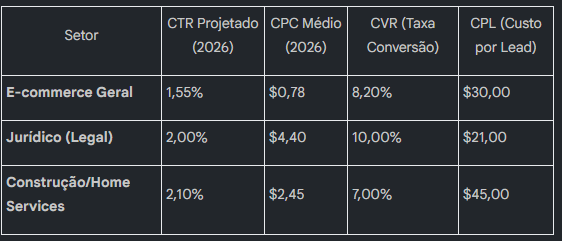
The increase in CPL in industries such as Construction and Legal is offset by predictive quality: AI-generated leads in 2026 are 40% more likely to close than leads in 2024.
Conclusion: The Next Step in Evolution
Advertising in 2026 is a symbiosis: heavy execution belongs to AI, but strategic sovereignty and creative authenticity belong to the human. Those who master their own data infrastructure and keep the human essence in their creatives won't just "beat the algorithm" — they'll lead it.
Final reflection: Is your ad account teaching AI how to find your best customers, or just wasting clicks on empty signals?
Tags
Redator
Redator oficial da e-hype